How to Switch from a High-Stress Startup to a Stable Corporate Job
Look, you're Googling this at 1:47 AM, aren't you? That Slack notification just buzzed. Your calendar for tomorrow looks like a Jackson Pollock painting. Your resting heart rate is a drum solo. I get it. The startup grind is a special kind of beautiful hell. You learned more in six months than most do in six years. But the cost? Yeah. We're talking about the cost. Let's be real: you're not just looking for a new job. You're looking for your sanity back.
The Bait-and-Switch: What You're *Actually* Signing Up For

Going corporate isn't "selling out." It's a strategic pivot. But trade-offs? Absolutely. Forget the foosball table and the "family" vibe. You're trading the rush of building the plane while flying it for the smooth, predictable flight path of a 747. Your job description will have actual, defined boundaries. Your projects will have actual, defined budgets. This is the core deal. You give up some chaotic magic for something profoundly human: predictability. Can you live with that? Honestly?
Translating "Startup" Into "Corporate-Speak" (Without Sounding Like a Robot)
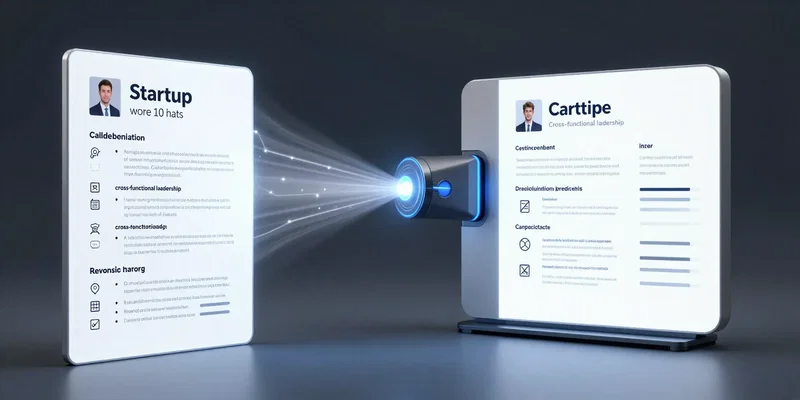
Here's your first hurdle. Your resume is a firehose of achievements, but it reads like gibberish to a corporate hiring manager. "Scaled user growth from 0 to 50k"? Great. *How?* "Managed a team of contractors"? Cool. *To do what, exactly?* You need to translate. "0 to 50k" becomes "Developed and executed a multi-channel user acquisition strategy resulting in 50,000 registered users within 18 months." See the difference? One is a fact. The other is a process. Corporates hire for process. Frame your chaos as a series of smart, repeatable decisions.
The Interview Minefield: Dodging the "Culture Fit" Bomb
They *will* ask: "Why leave a startup for here?" Do not say "for better work-life balance." Red flag. They'll hear "I'm lazy." Say this instead: "I've thrived in a high-velocity, build-from-zero environment. Now, I want to apply that scrappy, results-oriented mindset at scale, with the resources and structure to make a deeper, sustained impact." Flip the script. You're not running *from* stress; you're running *towards* impact. When they ask about your ideal pace, talk about sustainable productivity, not "less work."
Your First 90 Days: Surviving the Bureaucracy
This might sound ridiculous, but your first victory will be finding the form to order a pen. It's a different operating system. Your instinct will be to bypass, to hack, to just *do the thing*. Resist. For the first few months, play it straight. Learn the org chart—not just names, but the unofficial power brokers. Understand the approval matrix. Your startup "just ship it" energy is an asset, but now it's a scalpel, not a hammer. Use it to ask "why" and suggest efficiencies, not to tear down walls on day three.
The Quiet Joy of Logging Off
Then, it happens. A Tuesday. You finish your tasks. You check your calendar for tomorrow. It's... manageable. You close the laptop at 5:32 PM. And nothing happens. No panic. No guilt. You make dinner and actually taste it. You read a book. You stare at a wall, just because. This is the prize. This stability isn't boredom. It's the blank canvas your burnt-out brain desperately needed. You get to remember who you are outside of a crisis. That’s not selling out. That’s buying back in—to your own life.